This is Part 4 of the 16-part Kingdom of God series.
The Spectacle Problem That Shapes Our Faith
Why do we assume God’s work must be dramatic to matter? It is worth pausing on that question before rushing to answer it, because the assumption goes further than most of us recognize.
We live in a world trained by spectacle. Scale signals success, and visibility equals value. Platforms are large, metrics are public, and results are expected to be measurable. Even our spiritual imagination has absorbed this logic. If God is moving, we expect headlines, growth charts, and revival stories that travel fast. But what if our expectations about God’s work have been shaped more by cultural imagination than by Kingdom reality? What if we have mistaken noise for fruit?
Jesus revealed the Kingdom of God, and He is still revealing it. He names it and calls us to inhabit it, and when He reveals it, it rarely looks impressive.
Table of Contents
What the Mustard Seed Parable Means for Kingdom Perception
When Jesus speaks about the Kingdom, He reaches for ordinary things. The mustard seed parable meaning is easy to miss if you are looking for something spectacular.
“He put another parable before them, saying, ‘The kingdom of heaven is like a grain of mustard seed that a man took and sowed in his field. It is the smallest of all seeds, but when it has grown it is larger than all the garden plants and becomes a tree, so that the birds of the air come and make nests in its branches'” (Matthew 13:31-32, ESV).
The seed is small, buried and nearly invisible, and shelter grows from it. Jesus chooses this image because it describes the Kingdom accurately. The mustard seed parable meaning is about present hiddenness. The seed is already alive before anyone notices it growing.
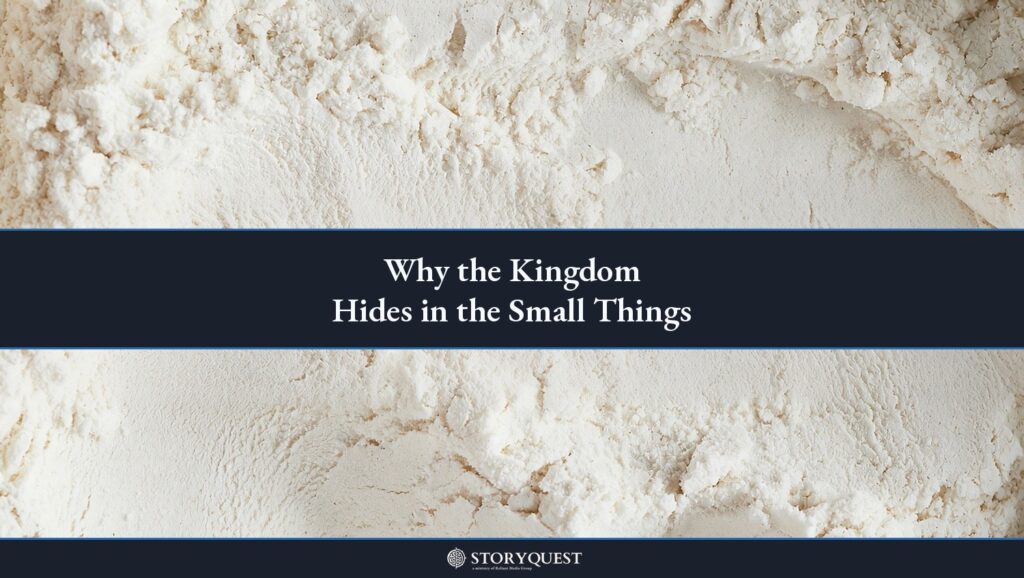
Then again: “The kingdom of heaven is like leaven that a woman took and hid in three measures of flour, till it was all leavened” (Matthew 13:33, ESV). The parable of the leaven follows the same pattern. The leaven works hidden and slow, from the inside out, through fermentation with no fireworks or spectacle. The parable of the yeast, as it is sometimes called, reveals a God who does His most important work beneath the surface of what we can observe and measure.
Even the story of the lost coin centers on something small enough to misplace in the dust (Luke 15:8-10, ESV). The Kingdom honors what others overlook. The pattern is clear: the Kingdom grows at the speed of roots. It advances through presence, through hidden trust, through ordinary obedience that rarely makes headlines. Jesus is retraining our sight.
Why Cultural Metrics Make the Kingdom Hard to See
If Jesus keeps pointing to the ordinary, why do we struggle to see it? Part of the answer lies in imagination. We live by stories more than we live by ideas. The stories we rehearse shape what feels plausible. If the story we inhabit says that power changes the world, we will look for power. If the story says visibility equals worth, we will look for visibility.
Over time, the Church has often centered clarity, order, and argument. These matter, and when imagination fades, faith becomes cerebral and results-driven. We begin to measure God’s activity the way a business measures growth: attendance, engagement, scale. Slow, unseen formation does not photograph well. And so, without noticing, we learn to distrust what feels small.
C.S. Lewis once observed that the most dangerous ideas are the ones we absorb without noticing. In his essay “The Weight of Glory,” he described ordinary human beings as creatures of such extraordinary significance that, if we could see them clearly, we would be tempted to fall down in worship. His point was perception. Lewis was arguing that the world is charged with more meaning than we have learned to see, and that our failure is a lack of trained attention. If Lewis is right, then the mustard seed parable meaning is a lesson about patience and also a confrontation with our inability to recognize glory when it appears in small and ordinary forms.
Dallas Willard spent decades making a similar argument from a different angle. He described the Kingdom of God as a present availability, the range of God’s effective will operating in the world right now. If that is true, then the smallest room in your house may be as spiritually significant as any stage. The Kingdom is already active in places we have been trained to dismiss.
Curt Thompson’s work in interpersonal neurobiology adds a practical dimension to this theological claim. Thompson emphasizes that the human brain is shaped by relational presence, by the quality of attention we give and receive in our closest relationships. Change happens in safety and consistency. The brain rewires through repeated, trustworthy encounters where someone is fully present. Which means the Kingdom may be advancing in conversations no one records, in prayers whispered while washing dishes, in apologies offered at kitchen tables.
Faithfulness in Small Things as Kingdom Work
We often treat small faithfulness as a prelude to impact, as if the hidden season is practice for the platform. But what if the small is the work itself?
In Luke’s Gospel, Jesus says, “One who is faithful in a very little is also faithful in much” (Luke 16:10, ESV). He says the little already matters. Faithfulness in small things is the substance of Kingdom participation.
The Kingdom honors smallness because God is already there, present and active, without waiting for growth or scale. Ordinary faithfulness becomes the soil where transformation takes root.
Stories help us see this in ways that metrics cannot. A spreadsheet cannot show you the courage it took for someone to forgive. A growth chart cannot reveal the slow healing inside a marriage, and a story can. Story makes the invisible visible, and in a culture trained by spectacle, we need help seeing again. The question worth sitting with is this: where might God already be working in your life or your organization that you have dismissed as not enough?
How Honest Storytelling Aligns Ministry with the Kingdom
This pressure shows up in ministry contexts too. Many ministries feel pressure to present growth as constant and dramatic because the fundraising environment rewards visible impact: charts, milestones, big numbers. The temptation is subtle. If the work looks small, will anyone care?
Dignity-first storytelling tells the truth without spectacle, honors people over projects, and refuses pity framing and exaggeration. When people encounter honest stories of slow change, trust forms, and that goes further than engagement. Sustainable generosity is built on authenticity.
Often the most meaningful stories are patient ones: a child learning to trust again, a volunteer showing up every week, a leader choosing integrity when no one is watching. These mustard seed moments rarely trend, and they shelter lives. And when ministries learn to name these small realities clearly, they align with the grain of the Kingdom itself.
The Kingdom That Is Already Here
The Kingdom of God is already present and available, without waiting for larger platforms or larger buildings. It is hidden in bread dough, buried in soil, and resting in the overlooked corners of your week.
We learn to see it, and as we see it, we begin to trust it. The Kingdom grows in ordinary places because God delights in meeting us there. He meets us in small rooms, with small acts, through steady love, as well as in sanctuaries and conferences.
This changes how we evaluate our lives and our leadership. The conversation that felt insignificant may be holy ground. The slow season may be root work. The unnoticed obedience may be shelter for someone else. The Kingdom grows without noise, and that does not make it weak.
For leaders with responsibility in ministry or the marketplace, the mustard seed parable meaning has direct implications. If the Kingdom advances through hiddenness, patience, and presence, then leadership itself must be formed by a different set of stories than the ones our culture tells about success.
FAQ
What is the mustard seed parable meaning?
The mustard seed parable in Matthew 13:31-32 teaches that the Kingdom of God begins in hiddenness and smallness. The seed is already alive before anyone notices it. Jesus uses this image to retrain our perception: the Kingdom advances through presence and patience.
What does the parable of the leaven teach about God’s Kingdom?
The parable of the leaven (Matthew 13:33, ESV) reveals that God works from the inside out. Leaven transforms the entire batch of dough, but it does so invisibly and slowly. The Kingdom permeates reality beneath the surface of what we can measure.
What does faithfulness in small things mean in the Bible?
In Luke 16:10, Jesus says that whoever is faithful in a very little is also faithful in much. He is describing the substance of Kingdom participation. Small faithfulness already matters because God is already present in it.
Why does the Kingdom of God feel hidden in daily life?
Because our imaginations have been formed by stories of spectacle, scale, and visible success. We expect God’s work to look impressive. Jesus consistently describes it as hidden, small, and ordinary. The Kingdom feels hidden because we have been trained to look for the wrong things.
How can ministries tell honest stories without exaggerating impact?
By practicing dignity-first storytelling: honoring people over projects, naming specific and concrete realities without inflating outcomes, and trusting that honest stories of slow change build more trust than dramatic narratives. Sustainable generosity is built on authenticity.
What is the difference between the parable of the leaven and the parable of the yeast?
They are the same parable. “Leaven” is the term used in most English Bible translations, including the ESV. “Yeast” is a modern equivalent that appears in some translations and in common speech. Both refer to the agent hidden in dough that transforms the whole batch from within, an image of how God’s Kingdom works invisibly and thoroughly.
Previous: Part 3: Why Did Jesus Speak in Parables About the Kingdom?
Next: Part 5: When the Story of Fear Shapes the Christian Life
At StoryQuest, we help leaders recover a Kingdom-shaped imagination for the work they already do — through story, Scripture, and guided reflection. If you’d like to try that, explore StoryQuest with us.
Sources
Scripture quotations are from The ESV Bible (The Holy Bible, English Standard Version), copyright 2001 by Crossway. Used by permission.
Formation voices referenced: Dallas Willard, The Divine Conspiracy (HarperOne, 1998). C.S. Lewis, “The Weight of Glory” (1941). Curt Thompson, The Soul of Shame and Anatomy of the Soul (IVP, 2015; IVP, 2010).